
OVERDUE Writer Eloise Hallo
It is not typical for a male artist of 19th century esteem to show so strong a preoccupation with female fashion as to garner an entire exhibition adjoining the two. John Singer Sargent’s place in time championed men’s issues as worthy topics of conversation and art — in a conveniently male-led public — and women’s issues, like fashion or the pesky discussion of equal rights, as belonging only to the interests of other women, or null and void. Sargent, atypical in this respect, needed to find new ways to mediate these cracks, which had otherwise lent themselves to one-note depictions of female sitters: sitters who were painted smilingly feather-dusting at home, as, to be quite frank, artists and audiences alike had little interest in, or knowledge of, narratives to other description. And so, in the late 1800’s, Sargent and his paintbrush of emancipation brought women, their fashioning, and, in so doing, notions of identity, to the foreground of high art and high society — to predictable resistance. Sargent’s post as a commissioned artist to this very society complicated his will to create outside of convention. As such, his oeuvre exists in two capacities: one, paid for and in alignment with the comforts of gendered roles, and another, modern and uncomfortable, chronicling an artistic mind and the world of tradition it was at odds with.
The exhibition’s foremost exhibit is titled ‘Women in Black’ and, shockingly, it delves into Sargent’s propensity to style his subjects in such tones. Innocuous as it may seem now, ‘women in black’ represented one principal status in his era — beyond class or social stature — to wear black meant to be mourning, more often than not a loss, typically, of the man that footnoted your identity. Yet, Mrs. John Jay Chapman, below, grieves no such turmoil. After her mother died, as a young girl, she was to raise her seven brothers and sisters, and it is in this strength Sargent found her to be an apt sitter. He dresses her in black not, as the Victorian era would have it be, because some solitary moment of loss changes her image in the public eye, but because her life, as a woman, has been enduringly hard, and she mourns the freedom of it being otherwise. As the Tate curators note, our autere’s ability to play with socialised structures such as these allowed his paintings duality: both modern and in line with tradition, they appeased the very high society they critiqued.

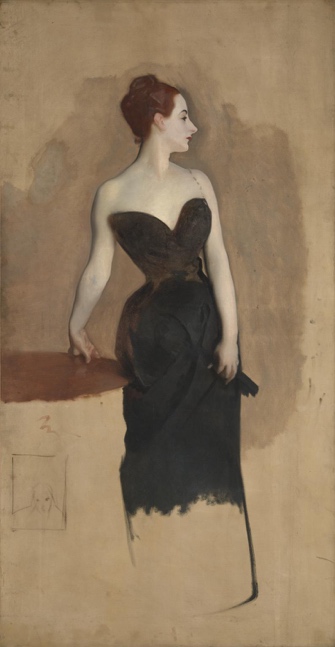
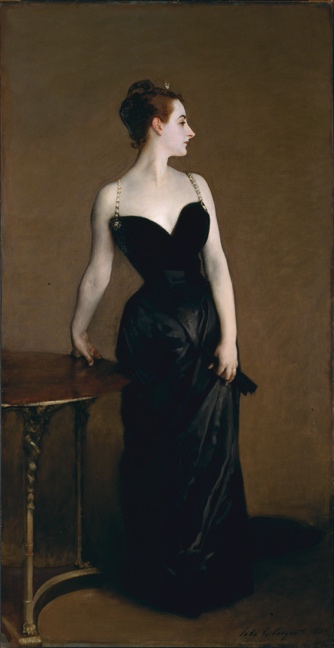
Sargent was, however, not always so tactful in this, and he would soon learn the importance of striking a balance between painting for his modern sitters and for the traditionalist audience that paid his bills. His portrait of Virginie Gautreau or ‘Madame X’, as we remember her now, remains the famed emblem of these odds. She was a muse well-known in artistic circles for her bold personal demeanour and style, two praises Sargent intended to capture in her imaging which initially — scandalously — saw one of her dress straps falling down. Its debut at the Salon of 1884 proved catastrophic; audiences denounced the work’s ‘indecency’, and the young artist was forced to re-work the piece and coyly paint a strap where none had been — a lesson, it seemed, in flying before he could walk. Over thirty years later, when the piece was sold to the MET, Sargent would unconvincingly aver, ‘I suppose it is the best thing I have done’.
Sargent was learning that stringent ideas surrounding femininity, masculinity, and the roles of both purveyed the society in which he worked, and he was beginning to realise these strongholds would exact influence over what his paintings — should he hope for remuneration
— were allowed to convey. This is no better seen than in his portrait of Henry Lee Higginson, which brandishes its sitter with notions of stoicism one might expect from a commissioned piece. Sargent employs old masterly technique to forefront Higginson’s battle-scar and the Civil War cavalry cloak that lies across his lap — yuck! — affording his sitter the dictatorial air he paid good money for.
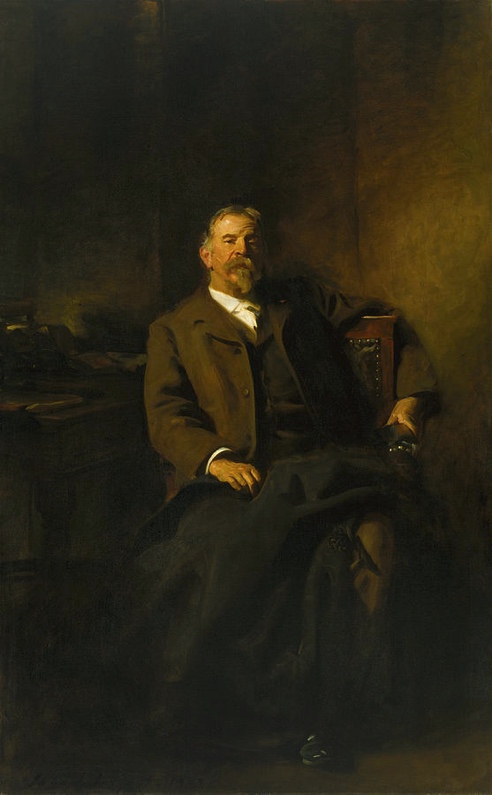
Left: Henry Lee Higginson, 1903
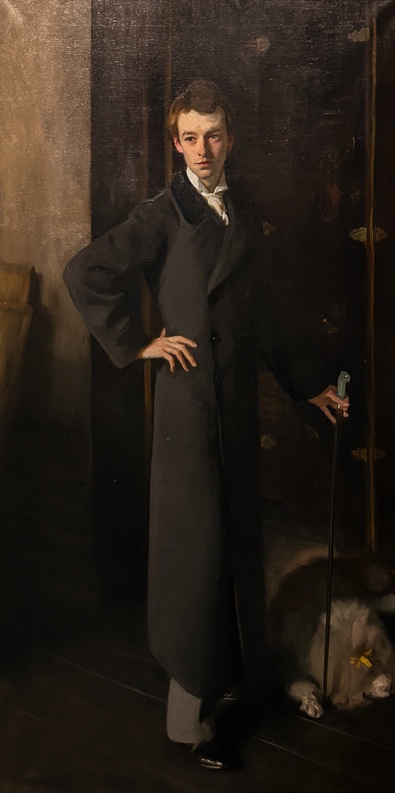
Right: W. Graham Robertson, 1894
However, as the Tate draws our attention to, in more personal works, Sargent maintained artistic truth to his subjects and was drawn to those who subverted such gendered conventions. His boy-like portrayal of W. Graham Robertson is entirely opposite in its suggestion about what makes masculinity artful. Through the confines of his muzzling, Sargent utilised his personal works to condemn the censorship of those he was paid to paint and to criticise the social structures that made it possible. Robertson’s fairy-like appearance and demure averted gaze bear more similarity with female portraiture of the era, and Sargent’s choice to enter its plea as valid art is but one of the ways he toyed with tradition.
Much of his attack had to do with re-contextualising old methods, which is what we see in his 1889 work of Flora Priestley. Sargent enacts his wealthed knowledge of fashion and colour to foreground Priestley’s face. Though the piece itself doesn’t invent any discernible technique, his will to situate her as both the subject and object of the painting affords Priestly more autonomy in the work than other artists of the era considered to be artful, much less practice. The same is true of Lady Agnew of Lochnaw, who stares directly, and intently, at her painter: madam, rather than muse. In both, Sargent withholds our ability to view either woman as passive; in so doing, he undermines the artistic tenets that would have sooner seen female sitters constrained to this space.
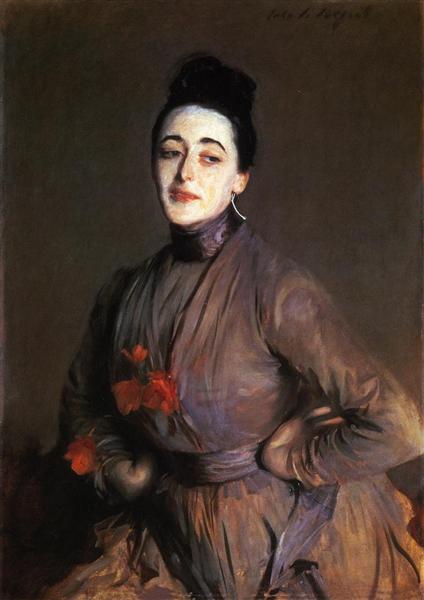

Left: Flora Priestley, 1889
Right: Lady Agnew of Lochnaw, 1892
But Sargent, ahead of his time as ever, understood the two-way street of tradition, particularly in thinking about gender. His portrait Dr Pozzi at Home is perhaps the key example in how re- contextualising his sitters forced audiences into the multitudes of their identity, removing them from the stagnancy of a painted setting. Samuel Pozzi, a well-established doctor to the upper classes, is seen in Sargent’s work — not to be labouring over a pallid Victorian child or chuffing smoke amidst a circle of round-bellied colleagues — but (fabulously) half-dressed and at home. Pozzi’s depiction, in the intimacy of his domestic
sphere, removes him from the easy-pickings of his doctorate and masculinity, and, quite unlike Higginson, we are invited into the more personal, vulnerable sides to his identity. There is, of course, the added fact that domestic spaces were traditionally female, and Sargent’s placing of Pozzi proves to be another of the ways he would employ his art to challenge such norms.
A similar gambit is at work in Nonchaloir (Repose), whose sitter, so too, is portrayed at home yet, as its title alludes to, reposed, reclined — two things women at home were seldom allowed to be. Sargent’s works that took focus on the domestic space were interested in the parts of people not commonly seen, and his choice to manoeuvre these intricacies into art of high society in so public a way challenged the conventions that had been happily affirmed in the canon for centuries.

Dr Pozzi at Home, 1881

In many ways, the truth to John Singer Sargent’s artistic intention was, for a long time, bemused, or perhaps half-bemused, by the coddled upper classes he worked for. Their belief that there existed a right and wrong to creative practice complicated Sargent’s ability to paint freely or to suggest such inflammatory sentiments as that a woman could look at her painter — imagine! His flitting between the two became evidence of contemporaneity and a world that was not ready for it — a veritable double agent who painted, stylistically, in accordance with tradition but was, ideologically, modern. Regardless, if you go to learn or simply to see its pretty dresses out of archive for the first time in years, Sargent and Fashion at the Tate is not one to miss.